
01
Residents of buildings without lifts or where lifts do not reach the unit
We plan walk-up building moves based on floor level, staircase width, corners, and item dimensions, confirming route restrictions beforehand.
Share your items, addresses and moving conditions, or send photos on WhatsApp first. We will follow up on anything else needed.
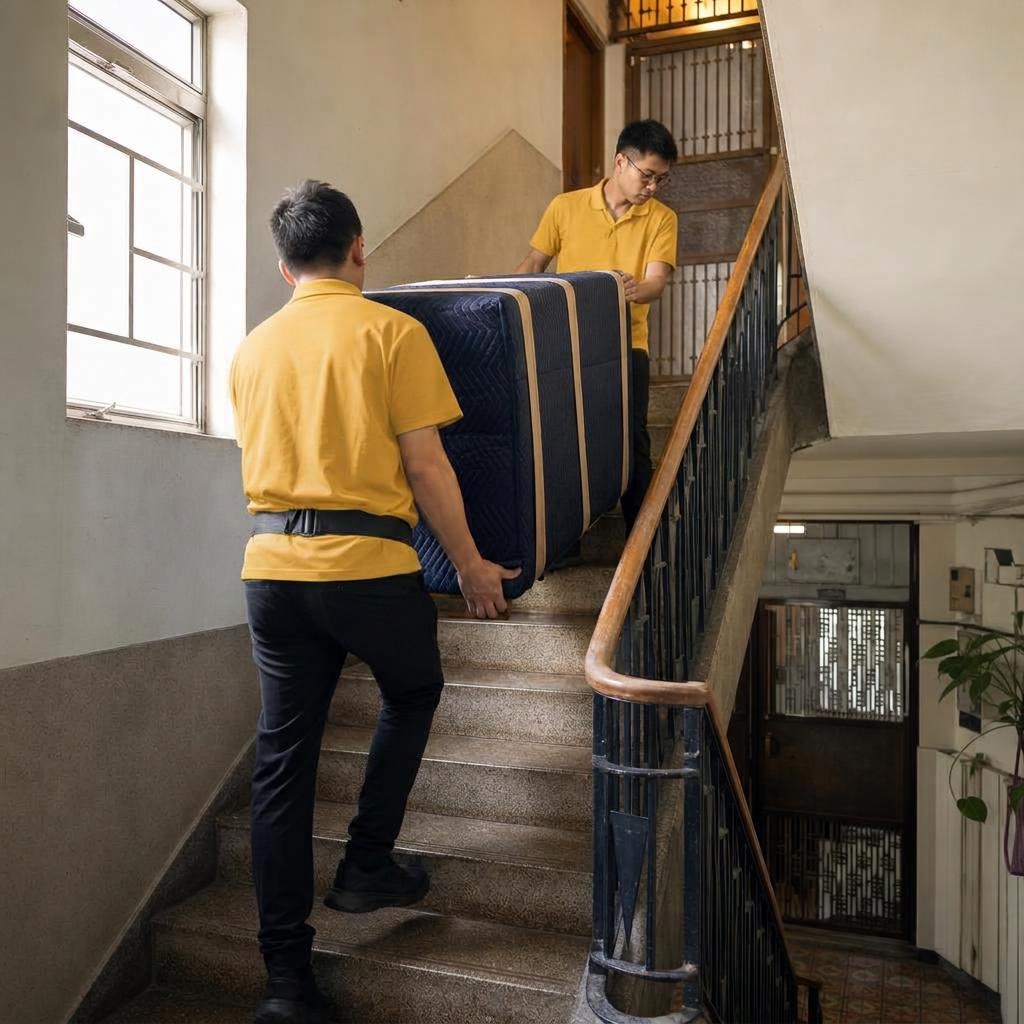
For walk-up buildings or residences requiring stairs, the key is to check the floor level, steps, landing corners, and item weight section by section. The team will first determine if items can be dismantled and safely passed through; the difficulty cannot be summarised simply by the 'floor number'.
Residents of buildings without lifts or where lifts do not reach the unit
Relocations where some large items cannot fit in the lift and must be moved via stairs
Older units with narrow landings, corridors, or door frames
Recording dimensions of large items, estimated weight, and demountable structures.
Checking each flight of steps, landing, handrail, and the narrowest corner at both addresses.
Determining the sequence of dismantling/reassembly, wrapping, and moving up/down stairs based on routes and item characteristics.
Keeping passages clear and verifying items after delivering them to the designated locations.
The number of floors, half-floors, and steps that must be walked at both addresses will affect the workload.
Landing depth, stair width, handrails, and ceiling height limit turning.
Dimensions, weight, and centre of gravity of each item must be judged individually.
The distance from the building entrance to the accessible parking location is also part of the moving route.
Checklist
Stairways and exits should be kept clear before moving; if the route or items are not suitable for safe manual moving, the plan must be adjusted first.
It is assessed by combining the actual flights of stairs at both addresses, quantity and weight of items, corners, and connection distances, rather than looking only at the address floor.
We will first assess if it can be safely dismantled; if dimensions still do not fit, alternative methods must be discussed; it cannot be guaranteed that it can be moved via the original route.
Yes, items can be sorted by size; items suitable for the lift and those requiring stairs will be assessed separately.
Learn how packages, furniture, dismantling and common extras are priced.
Moving scenarios
No Lift Stairs Moving is planned around the route, site rules, timing and permissions. Confirm the scope and responsibilities before scheduling the move.
Moving scenarios
Narrow Stair Turns Moving is planned around the route, site rules, timing and permissions. Confirm the scope and responsibilities before scheduling the move.